
You know that moment when you’re spiraling, feeling completely out of control, and your brain throws in the bonus punch: “Why are you like this?”
Not helpful, brain.
Most of us have lived far too long thinking our reactions are evidence of a broken character. That our anxiety means we’re weak. That our overreactions mean we’re dramatic. That our inability to “just let things go” is some deep flaw in our DNA.
But what if the real problem isn’t you… it’s that no one ever taught you how your mind works?
This is where psychoeducation walks in like a steady-handed friend who finally sits you down and says, “Hey, here’s what’s actually going on.” And in that moment, something huge shifts: you realize it was never just about willpower or being “too sensitive.” It was about information you didn’t know you were missing.
Let’s talk about what psychoeducation really is, and how it could be the missing piece between self-blame and actual healing.
Nobody ever taught you how your mind works
You were handed a brain, a body, a big pile of feelings, and absolutely zero instruction manual. Sound familiar?
It’s not your fault you didn’t know what anxiety really was until it swallowed your social life whole. Or that you didn’t understand trauma until your relationships started unraveling for reasons you couldn’t explain. The truth is, most of us were never taught the most basic stuff about our mental health.
We learned how to multiply fractions and label mitochondria in a cell, but nobody pulled us aside to say: “Hey, here’s how your nervous system responds to threat,” or “Here’s what depression does to your motivation,” or “Here’s how early experiences shape your beliefs about yourself.”
So we made guesses. We filled in the blanks with shame.
You grew up thinking your reactions were just “you”

If you’re like a lot of people, you’ve spent years assuming your emotional reactions were some kind of built-in defect. Like, “Why do I always shut down during conflict?” or “Why can’t I just be happy like everyone else?”
Without understanding the why behind your patterns, it’s easy to assume those patterns are you.
But here’s the truth: many of the things you call “personality flaws” are actually stress responses. They’re adaptations. Survival tactics. Your mind wasn’t trying to be difficult. It was trying to protect you with the limited resources it had at the time.
You weren’t broken. You were coping.
Trauma, stress, and mental illness were never explained
Let’s be honest: if trauma was ever mentioned in your household, it probably came with a scoff or an eye roll. Stress? Just something to “deal with.” Mental illness? Either taboo, ignored, or joked about in that uncomfortable way that tells you to never bring it up again.
So where were you supposed to turn?
Without explanation, you grew up feeling things you didn’t have names for. Panic that felt like dying. Depression that felt like failure. Emotional numbness that looked like laziness. And instead of being met with clarity or care, you were often met with judgment… even your own.
Psychoeducation doesn’t just label these experiences; it translates them. It says, “Here’s what this is. Here’s where it comes from. Here’s what you can do.”
You’re not alone if you’ve asked ‘Why me?’ and this story might help.
Psychoeducation helps connect the dots
Imagine trying to do a puzzle without the picture on the box. That’s what trying to heal without psychoeducation feels like. You’re just shuffling around confusing emotions and tangled behaviors, hoping they’ll make sense eventually.
Psychoeducation gives you the picture.
It helps you understand how your experiences, biology, and beliefs interact. It breaks down things like attachment, trauma responses, cognitive distortions, and stress cycles in ways that finally make your reactions make sense. It’s not memorizing psychological jargon. It’s seeing your life with more compassion and clarity.
Suddenly, you’re not just a mess. You’re a map. And the pieces start clicking into place.
What happens when you don’t understand your own mind
Here’s the part nobody likes to admit (but if you’ve lived it, you already know):
When you don’t understand what’s going on in your brain, you turn that confusion into self-blame. You make up stories about how you’re not trying hard enough, not strong enough, not “normal” enough. But the truth is…
You blame yourself for things that aren’t your fault
Ever catch yourself saying things like “I’m just too much,” “I ruin everything,” or “Why can’t I be normal for once?”
That’s not self-awareness. That’s self-punishment.
When you lack the tools to name what’s really happening, you end up taking responsibility for things that were never yours to carry. Childhood emotional neglect? That wasn’t your fault. Growing up in chaos? Not your doing. The anxious spiral you fall into during conflict? It’s not a character flaw. It’s your nervous system doing its job a little too well.
But without psychoeducational understanding, all those things just feel like proof that you’re the problem. You’re not.
You stay stuck in survival mode without realizing it
Survival mode doesn’t always look like panic attacks and meltdowns. Sometimes it looks like “being fine.” Being productive. Being the one who handles everything… until you crash.
If no one ever explained what chronic stress does to a body, or how unresolved trauma can keep your brain in a perpetual fight-or-flight state, you might not even realize how long you’ve been running on empty.
Psychoeducation shines a light on all the invisible threads tying your exhaustion, irritability, perfectionism (or shutdown) to deeper patterns. Once you see it, you can change it.
Psychoeducation is a form of care

We talk a lot about self-care these days. Bubble baths, journaling, breathwork. And while those things do matter, here’s something that rarely gets mentioned: being taught how your own mind works is care.
It’s care in the most foundational, affirming sense. Because when someone sits with you and says, “You’re not crazy. You’re human. Let me show you why this is happening,” they’re giving you permission. To stop blaming yourself. To feel what you feel. To be a work in progress.
Teaching people how the mind works is part of healing
You wouldn’t expect someone to fix their car without understanding what’s under the hood. So why do we expect people to fix their lives without knowing what’s happening in their minds?
Understanding is part of recovery. When you know how trauma rewires the brain, or how core beliefs shape your reactions, or how anxiety impacts your body, you stop fighting yourself and start working with yourself. That’s when real healing becomes possible.
Understanding gives you more choice, not more shame
There’s this fear sometimes that “if I understand why I am the way I am, I’ll just feel worse.” Like the knowledge will somehow confirm your worst fears about yourself.
But here’s what psychoeducation actually does: It gives you context and not condemnation.
It doesn’t say, “You’re damaged.” It says, “Here’s how your system adapted. Here’s how you can adapt differently now.” And with that context comes a radical gift: choice.
The choice to respond instead of react. The choice to shift patterns instead of repeat them. The choice to rewrite the story instead of reliving the same chapter over and over.
Understanding doesn’t lock you into who you’ve been. It opens the door to who you can become.
At the Mentally STRONG Clinic, we teach you what’s going on
You don’t walk into the Mentally STRONG Clinic and get handed a vague diagnosis and a prescription to “cope.” You get answers. You get a roadmap. You get to understand you. Finally.
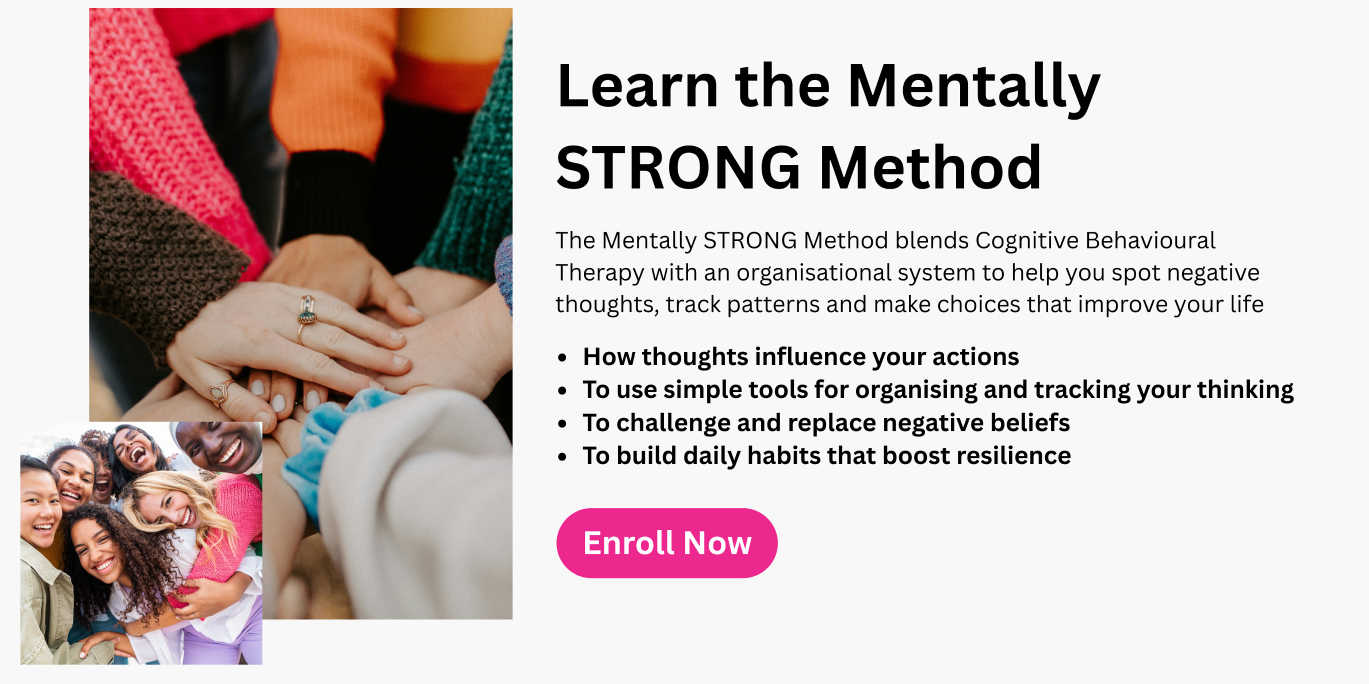
Because psychoeducation isn’t an optional bonus here. It’s woven into every single part of your care. Whether you’re working one-on-one with a provider, sitting in group coaching, or exploring the Mentally STRONG Method on your own, learning about your mind is part of your healing. Always.
Psychoeducation is part of every session

From the first time you sit down in the clinic, your provider walks you through how your mind works not in a lecture-y, “let me tell you about the amygdala” way, but in a way that connects your story to what’s happening internally. Each session helps you spot your patterns, understand the roots of your reactions, and start building new tools that are actually doable in real life. We don’t just talk about what’s hard. We help you learn why it feels hard, and what to do about it.
You’re not left in the dark. You’re not left guessing. And you’re definitely not left alone.
You can walk in, book coaching, or explore the MS Method
Not everyone’s healing journey looks the same, and that’s the point. At the Mentally STRONG Clinic, you can:
- Walk in for an assessment during business hours (no appointment necessary).
- Book a coaching session that teaches you how to process thoughts and emotions using the Mentally STRONG Method.
- Start self-paced learning through our courses if you want to dig into your healing on your own terms.
This isn’t a one-size-fits-all program. It’s a toolbox, a support system, and a strategy designed around you. And every option centers around the same core belief: you deserve to understand yourself.
You don’t have to keep guessing why you feel the way you do
You’ve spent enough time trying to make sense of things in the dark. Enough time blaming yourself for patterns you didn’t choose. Enough time thinking healing meant “just trying harder.”
Here’s what you need to know:
You don’t have to keep guessing. You can learn.
You can learn what anxiety really is. You can learn what trauma does to a nervous system. You can learn how thoughts, beliefs, and behaviors connect and how to shift them. When you learn, you begin to soften. You begin to forgive yourself. You begin to rebuild from understanding.
Psychoeducation doesn’t fix everything. But it’s often the first brick in the foundation. The moment when healing stops being a vague hope and starts becoming something you actually know how to do. Explore psychoeducation at Mentally STRONG to see how learning about your mind can change everything.”
You don’t have to keep feeling confused, broken, or behind..